The Power of Precision: Understanding Court Building Icons and Vector Graphics for Digital Applications
In the rapidly evolving landscape of digital design, the smallest elements often carry the most significant weight. A single icon can communicate a complex concept instantly, guiding users through an application or clarifying information on a website. Among these essential visual tools, court building icons stand out as critical assets for legal tech, government portals, real estate platforms, and educational resources. Whether you are a seasoned graphic designer or a developer looking to enhance user experience, understanding the value of high-quality vector graphics is paramount.
Welcome to a comprehensive guide on leveraging professional vector icons, specifically focusing on architectural representations like court buildings. This article explores why format matters, how resolution impacts your project, and why downloading a versatile ZIP file containing EPS, PNG, and SVG formats is a strategic move for any modern creative professional.
Why Vector Icons Matter in Modern Web and Mobile Design
To truly appreciate the utility of a court building icon, one must first understand the underlying technology: vector graphics. Unlike raster images (such as standard JPEGs or low-resolution bitmaps), which are made of a fixed grid of pixels, vector graphics are defined by mathematical equations. This distinction is not merely technical; it is the difference between an image that looks crisp on a small screen and one that becomes pixelated and blurry when enlarged.
In the context of mobile and web applications, scalability is non-negotiable. Users access content on devices ranging from smartwatches to 4K monitors. A vector icon ensures that the silhouette of a courthouse remains sharp, clean, and professional regardless of the display size. This consistency builds trust—a crucial factor for applications dealing with legal services, civic information, or official documentation.
The Versatility of Multi-Format Downloads
When purchasing or sourcing design assets, the delivery method is just as important as the design itself. A robust resource typically comes packaged in a ZIP file containing multiple file types. Let’s break down why this variety is essential for a seamless workflow:
- EPS (Encapsulated PostScript): This is the industry standard for print and professional editing. If you need to take your court building icon into Adobe Illustrator or InDesign to modify colors, add effects, or integrate it into a large-scale brochure, the EPS file provides the flexibility you need without losing quality.
- SVG (Scalable Vector Graphics): For web developers, SVG is the gold standard. It allows icons to be embedded directly into HTML code, ensuring they load quickly and remain perfectly sharp on any device. SVGs are also interactive and can be animated using CSS or JavaScript, adding a dynamic layer to static interfaces.
- PNG (Portable Network Graphics): While vectors are ideal, sometimes a quick drop-in solution is needed. High-resolution PNG files with transparent backgrounds allow designers to place the icon over various colored backgrounds or textures without worrying about unsightly white boxes. These are perfect for rapid prototyping or use in environments where vector editing isn't feasible.
The Significance of Resolution: Beyond the Basics
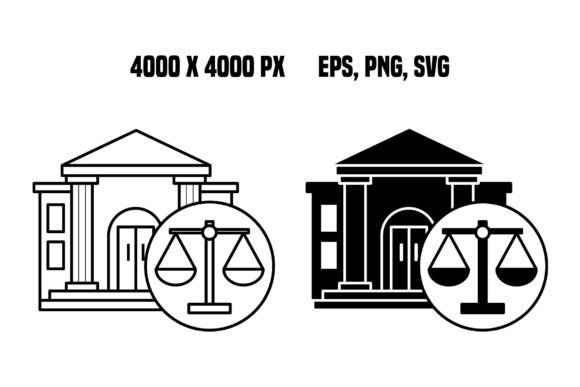
A common misunderstanding among beginners is assuming that all "high-quality" images are created equal. However, resolution plays a pivotal role in the final output. The specific asset set we are discussing boasts a staggering resolution of 300 DPI (dots per inch) at dimensions of 4000 x 4000 pixels. Why does this matter?
Standard web images often hover around 72 DPI, which is sufficient for screens but disastrous for print. If you were to print a standard web icon on a business card or a legal flyer, it would likely appear fuzzy or jagged. By providing a 300 DPI file, the creator ensures that the icon is print-ready right out of the box. Furthermore, the 4000 x 4000 pixel dimension means that even if you zoom in significantly for a hero banner on a desktop site, the details of the architecture—the columns, the steps, the dome—remain incredibly detailed.
This level of detail is particularly important for civic and legal branding. A courthouse represents authority, justice, and stability. A blurry or low-res icon undermines that message. High-resolution assets ensure that the visual language matches the gravity of the subject matter.
Practical Applications: Where Do Court Building Icons Fit?
The utility of a well-designed court building icon extends far beyond simple decoration. It serves functional purposes across various sectors of modern life and business. Here are several ways these assets are integrated into daily digital experiences:
- Legal Tech Applications: Apps designed for lawyers, paralegals, or self-represented litigants rely on clear navigation. An icon representing a "Court Location" or "Hearing Schedule" helps users find critical information instantly.
- Government Portals: Civic websites often require intuitive maps and directories. Using a consistent, recognizable icon for municipal buildings helps citizens navigate complex bureaucratic structures with ease.
- Real Estate Platforms: When listing properties near downtown areas or government districts, agents often use icons to denote proximity to key landmarks. A court building icon can indicate a property's location relative to the city center or judicial district.
- Educational Materials: In e-learning courses about civics, law, or history, visual aids are essential. High-quality vectors can be used in presentations, textbooks, and online modules to illustrate concepts without distracting from the text.
Common Misunderstandings About Icon Usage
Despite their ubiquity, there are several myths surrounding the use of icons in design. One prevalent assumption is that "free" icons found on random websites are always sufficient. While free resources exist, they often lack the transparency, resolution, and licensing clarity of premium assets. Using a low-quality icon can lead to copyright issues or a unprofessional appearance that damages a brand's reputation.
Another misconception is that once an icon is downloaded, it cannot be modified. With the inclusion of vector design elements in EPS and SVG formats, users have full control. You can change the color palette to match your brand guidelines, simplify the lines for a minimalist look, or combine it with other elements to create a unique composition. The transparency of the background ensures that the icon blends seamlessly into any design environment.
Optimizing for User Experience (UX)
In the realm of UX design, every millisecond counts. Large, uncompressed image files can slow down a website, leading to higher bounce rates. This is where the versatility of the provided ZIP file shines. Developers can use the lightweight SVG version for web pages to ensure fast loading times, while reserving the high-resolution PNG or EPS files for marketing materials or print collateral. This dual approach optimizes performance without sacrificing visual fidelity.
Furthermore, accessibility is a growing concern in digital design. Clear, distinct icons help users with visual impairments or cognitive disabilities navigate interfaces more effectively. A well-defined court building icon, with its distinct architectural features, is easier to recognize than abstract symbols, thereby improving the overall inclusivity of the application.
Conclusion: Elevating Your Projects with Professional Assets
Whether you are building a sophisticated mobile app for legal professionals or designing a community website for local governance, the quality of your visual assets defines the success of your project. The combination of court building icons in multiple formats—EPS, PNG, and SVG—offers the flexibility and quality required for today's diverse media landscape.
By choosing high-resolution, 300 DPI files with transparent backgrounds, you ensure that your designs are future-proof, scalable, and professionally polished. These assets do more than just fill space; they communicate authority, clarity, and attention to detail. Thank you for visiting the store and exploring the possibilities of vector design. We hope this guide has clarified the importance of investing in quality graphics and inspired you to create more impactful digital experiences.
As you continue your journey in design and development, remember that the devil is in the details. A single, well-chosen icon can make all the difference between a confusing interface and a seamless user journey. Embrace the power of vectors, and let your projects speak volumes through precision and clarity.